

-
Compact string garlic chopper
Vendor:Hachoir CuisineRegular price $36.00 USDRegular priceUnit price per$45.00 USDSale price $36.00 USDSale -
Compact pale blue string cutter
Vendor:Hachoir CuisineRegular price $23.00 USDRegular priceUnit price per$29.00 USDSale price $23.00 USDSale -

 Sold out
Compact green string cutter
Vendor:Hachoir CuisineRegular price $23.00 USDRegular priceUnit price per$29.00 USDSale price $23.00 USDSold out -
600 ml string chopper
Vendor:Hachoir CuisineRegular price $30.00 USDRegular priceUnit price per$38.00 USDSale price $30.00 USDSale -
String chopper 1000 ml
Vendor:Hachoir CuisineRegular price $30.00 USDRegular priceUnit price per$37.00 USDSale price $30.00 USDSale -
Blue 900 ml string chopper
Vendor:Hachoir CuisineRegular price $32.00 USDRegular priceUnit price per$40.00 USDSale price $32.00 USDSale -
Pink 500 ml string chopper
Vendor:Hachoir CuisineRegular price $32.00 USDRegular priceUnit price per$40.00 USDSale price $32.00 USDSale -
Green 500 ml string chopper
Vendor:Hachoir CuisineRegular price $32.00 USDRegular priceUnit price per$40.00 USDSale price $32.00 USDSale -
Green 900 ml string chopper
Vendor:Hachoir CuisineRegular price $32.00 USDRegular priceUnit price per$40.00 USDSale price $32.00 USDSale -
Pink 900 ml string chopper
Vendor:Hachoir CuisineRegular price $32.00 USDRegular priceUnit price per$40.00 USDSale price $32.00 USDSale -
Blue 500 ml twine cutter
Vendor:Hachoir CuisineRegular price $32.00 USDRegular priceUnit price per$40.00 USDSale price $32.00 USDSale -
Pink multifunctional twine cutter
Vendor:Hachoir CuisineRegular price $23.00 USDRegular priceUnit price per$29.00 USDSale price $23.00 USDSale -
Blue multifunctional twine cutter
Vendor:Hachoir CuisineRegular price $23.00 USDRegular priceUnit price per$29.00 USDSale price $23.00 USDSale -
Pink rotary chopper 400 ml
Vendor:Hachoir CuisineRegular price $27.00 USDRegular priceUnit price per$34.00 USDSale price $27.00 USDSale -
Green rotary chopper 200 ml
Vendor:Hachoir CuisineRegular price $27.00 USDRegular priceUnit price per$34.00 USDSale price $27.00 USDSale -
Pink rotary chopper 200 ml
Vendor:Hachoir CuisineRegular price $27.00 USDRegular priceUnit price per$34.00 USDSale price $27.00 USDSale







What to know about this collection
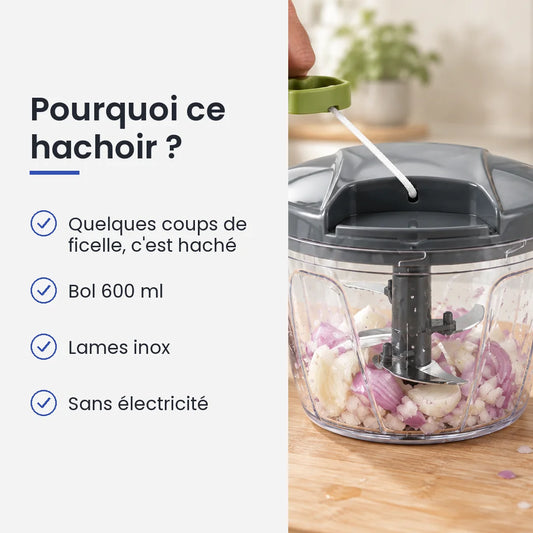
The principle is as simple as it is effective: place the food in the bowl, close the lid, then pull the cord and the blades spin. A few pulls are enough for a clove of garlic, a shallot, or a handful of parsley, and you can add more if you want a finer chop. No power connection, no motor noise, no adjustment.
What capacity to choose for a rope chopper?
The capacity is the real selection criterion, far before the color.
- Compact format: for a clove of garlic, a few herbs, or spices, on a daily basis. It fits in a drawer.
- 500 to 600 ml: for individual, two-person, or small family preparations: an onion, a sauce base, an herb sauce.
- 900 ml to 1 liter: for large family preparations, several onions, or a soup base at once.
Be careful not to overfill: a bowl loaded beyond two-thirds chops unevenly, the pieces on top spinning without meeting the blades. Two batches are better than an overfull bowl.
What can be chopped with a rope chopper?
The product sheets for our models mention garlic, onions, fresh herbs, and vegetables, as well as spices for the compact format. Cut the vegetables into 2 to 3 cm pieces before putting them in the bowl: a whole vegetable blocks the blades and gives an uneven result.
For herbs, pull in small series and check the texture in between: too chopped, they release their water and turn into paste. For raw meat, the rope chopper is not the right tool: a manual meat chopper with a crank and grid does this job without electricity.
Rope, crank, or twist: which one to choose?
The rope chopper is the fastest to take out and put away, and the easiest to use. The crank gives finer control, the twist is suitable for one or two cloves of garlic in a small box. For garlic in particular, our selection of garlic presses and garlic choppers helps to slice, and all the mechanisms are gathered in the manual chopper collection.
Maintenance: cleaning in a few steps
On all the rope models in this selection, the bowl is easily disassembled. Rinse the bowl and the blades right after use, before the garlic or herb residues dry, then let dry completely before reassembling. Handle the blades by their central axis: they are made of stainless steel and stay sharp.
Our guide reviews what can be chopped with a rope, and with what gestures.
Frequently asked questions about the rope chopper
How does a rope chopper work?
Each pull on the cord makes the stainless steel blades spin in the closed bowl: the more you pull, the finer the chop. There is no motor or battery, so nothing to recharge.
Is there a mini manual rope chopper?
Yes: the compact formats in this selection, in green, in purple, or with stainless steel blades for garlic, are designed for small daily preparations. They are suitable for garlic, herbs, and vegetables, the compact model with stainless steel blades also accepts spices, and all fit in a drawer.
Which compact manual chopper with blades to choose for garlic?
The compact manual rope chopper with stainless steel blades is designed for garlic, herbs, and spices. If you prefer to crush garlic rather than chop it, our garlic press and garlic chopper collection offers garlic presses and twist choppers.
Does a manual chopper with a rope also chop onions?
Yes, it is one of its main uses. Cut the onion into quarters, pull a few times, and check the texture. The closed bowl also keeps the onion vapors inside, which limits tears. For several onions at once, prefer a 900 ml or 1 liter bowl.