

-
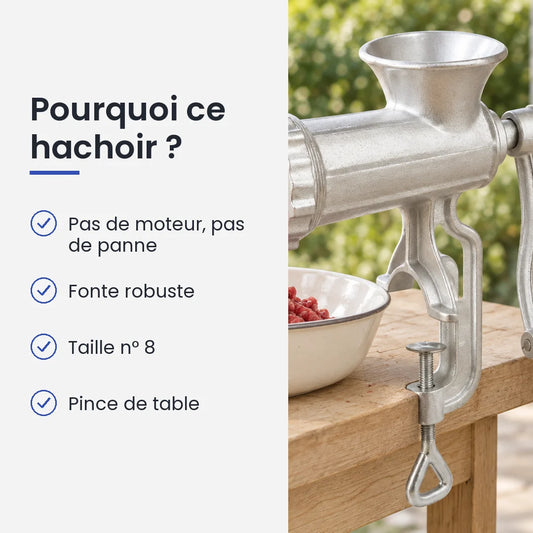
No. 8 cast iron meat grinder
Vendor:Hachoir CuisineRegular price $42.00 USDRegular priceUnit price per$52.00 USDSale price $42.00 USDSale -
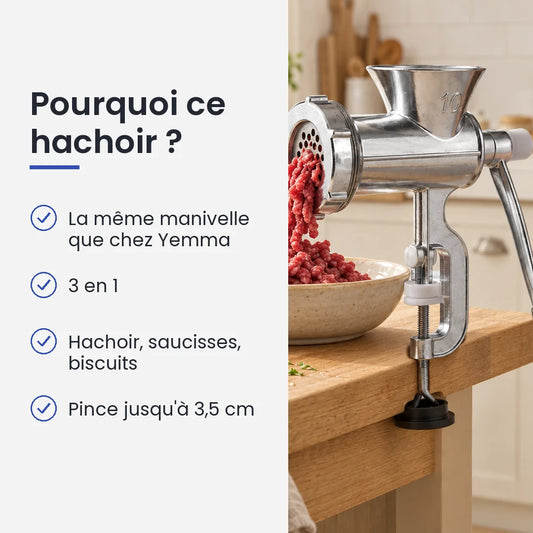
Lightweight 3-in-1 manual meat grinder
Vendor:Hachoir CuisineRegular price $86.00 USDRegular priceUnit price per$102.00 USDSale price $86.00 USDSale -
Manual aluminum meat grinder, 3 attachments
Vendor:Hachoir CuisineRegular price $67.00 USDRegular priceUnit price per$83.00 USDSale price $67.00 USDSale -
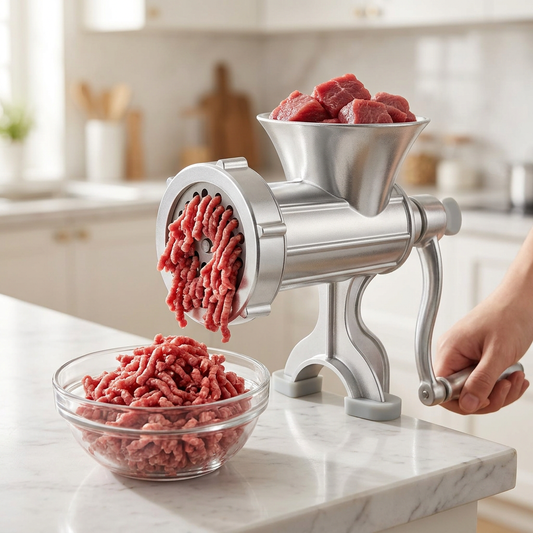
Manual aluminum meat grinder with suction cup
Vendor:Hachoir CuisineRegular price $83.00 USDRegular priceUnit price per$102.00 USDSale price $83.00 USDSale -
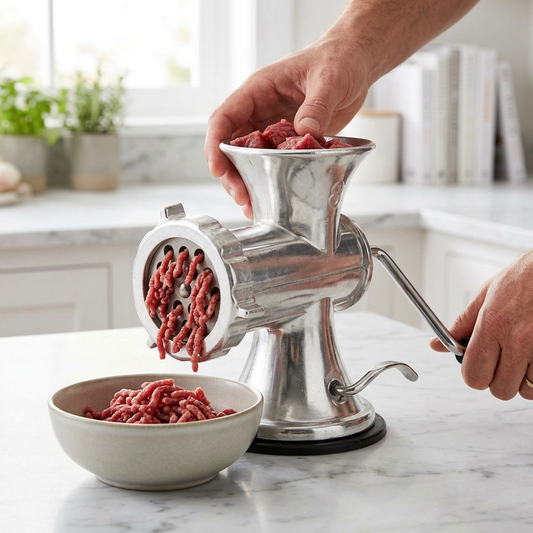
Manual suction meat chopper, orange
Vendor:Hachoir CuisineRegular price $52.00 USDRegular priceUnit price per$64.00 USDSale price $52.00 USDSale -
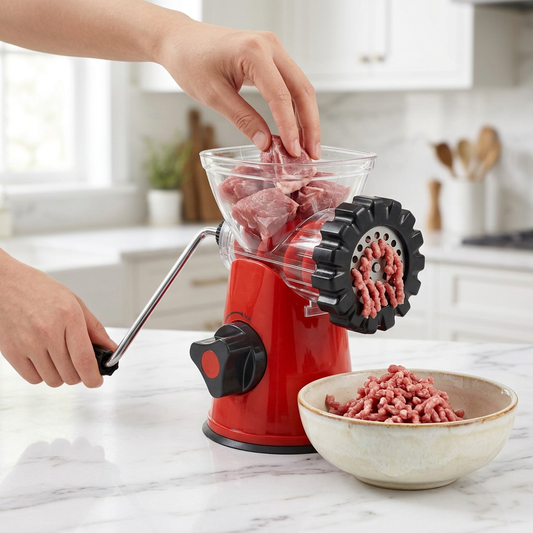
Manual meat grinder with red suction cup, with sausage attachment
Vendor:Hachoir CuisineRegular price $68.00 USDRegular priceUnit price per$84.00 USDSale price $68.00 USDSale






What to know about this collection
A manual meat grinder grinds meat without electricity, using only the power of the crank. The mechanism is entirely mechanical: no motor, no electronics, so nothing breaks down after a few years.
It is suitable for volumes of 500 g to 2 kg per session: evening ground beef, stuffing, meatballs, pâté, or a batch of sausages. Beyond that, the effort at the crank becomes the only limit.
Why choose a manual model rather than an electric one
The grinding itself is of equivalent quality. What sets the manual model apart is what it allows you to do in addition.
The meat does not heat up. A motor that runs for a long time heats the meat through friction, which melts the fat and makes the texture pasty. With a crank, the temperature remains stable. This is crucial for tartare, fine stuffing, or a pâté where the fat must remain in distinct pieces.
You control the pace. You feel the resistance, you slow down on a tough piece, you stop to check the texture. A motor, on the other hand, pushes at a constant speed no matter what.
Cast iron, stainless steel, or aluminum: what material for a manual meat grinder?
Cast iron is the traditional material. Heavy, it stabilizes the device during use, which matters when you are forcing through firm meat. Our size 8 cast iron model is designed for regular and intensive use. However, it requires complete drying and a light coating of oil after each wash, otherwise it will oxidize.
The aluminum alloy equips our 3-in-1 grinders: a high-resistance body and forged alloy blades, for a lighter device to take out and put away. The PP handle version is the lightest and most manageable. If you mainly grind firm meats, the more massive cast iron body provides greater stability.
Stainless steel, on the other hand, does not rust and does not retain odors: a rinse with hot water and quick drying are enough. Lighter than cast iron of the same size, it requires a tightly clamped table clamp to remain stable. This selection does not yet have an all-stainless steel model, but the guide will help you compare.
| Criterion | Cast iron | Stainless steel | Aluminum alloy |
|---|---|---|---|
| Stability during use | Excellent, the device is heavy | Good with a tightly clamped clamp | Fair for medium quantities |
| Rust | Susceptible to moisture without oiling | Does not rust | Holds up well if dried quickly |
| Washing | By hand, drying then oiling | Easy, dishwasher safe depending on the model | By hand |
| Weight | Heavy | Medium | Light |
| Ideal use | Regular and intensive | Frequent, hygiene first | Occasional and versatile |
What size manual meat grinder: n°5, n°8, or n°10?
The number indicates the diameter of the grinding body, therefore the size of the compatible plates and knife. The n°5 is suitable for small quantities. The n°8, the one for our cast iron model, is the family standard and the best compromise between output and effort. The n°10 and n°12 take in larger pieces with each turn, at the cost of a more pronounced effort at the crank. A plate is never universal: check the correspondence with the number of your device before buying a part. Our article grinder n°5, n°8, n°10: what does the number mean details each size.
Accessories and mounting: the two points to check
The accessories provided
The cast iron model comes with a sausage kit and everything needed to obtain different grinding textures. The 3-in-1 grinders add a sausage stuffer and a cookie mold. For the texture, remember three benchmarks: a fine plate of 3 to 4.5 mm for pâtés and smooth stuffings, 6 to 8 mm for ground beef and meatballs, 10 to 12 mm for sausages, where the meat must remain coarse to retain its juices.
Mounting to the worktop
A table clamp remains stable even when you force. On our 3-in-1 grinders, it adjusts up to 6 cm in thickness on the standard version and 3.5 cm on the PP handle version. Measure the thickness of your worktop before choosing.
How to obtain a clean grind from the first use
The assembly determines the entire result: auger in the body, knife on the shaft, cutting side pressed against the plate, then ring tightened by hand without forcing. A knife mounted upside down does not cut, it crushes.
Cut the meat into 2 to 3 cm cubes and pass them 15 to 20 minutes in the freezer before grinding. A firm meat cuts cleanly instead of being crushed. Always guide the pieces with a pusher, never with your fingers. The choice of diameter is detailed in which plate to choose according to the preparation.
For regular use beyond two kilos per session, compare with the electric meat grinder range, or browse all the models in the meat grinder collection.
Is the manual meat grinder dishwasher safe?
It all depends on the metal. Cast iron, never: one cycle is enough to make it rust. Wash it by hand, dry each piece immediately and apply a very thin film of food-grade oil before putting it away. Aluminum is also washed by hand, because it turns black in the dishwasher. For stainless steel, follow the instructions: some parts support it, others do not. In any case, disassemble the device right after use and rinse with cold water, before the meat dries in the auger.
Frequently asked questions about the manual meat grinder
How to use a manual meat grinder?
First, fix the device with its table clamp, mount the auger, the knife then the plate, and tighten the ring by hand. Introduce the cold meat in cubes from the top, push it with a pusher and turn the crank in a regular movement. Our step-by-step guide explains how to use a manual meat grinder, from assembly to cleaning.
Is there a professional manual meat grinder?
The size 8 cast iron model is designed for regular and intensive use, with a stable mounting for large family preparations. If you grind several kilos each session, several times a week, an electric grinder with a plate will save you time and effort.
Does an old manual meat grinder work like a new model?
Yes, the principle has not changed: an auger pushes the meat towards the knife and the plate. On an old device, especially check the number of the body before buying a replacement plate or knife.
Manual meat grinder, manual meat machine: is it the same device?
Yes. Meat grinder, meat machine, meat chopper or manual meat grinder refer to the same crank tool.