

-
Zinc garlic chopper and press
Vendor:Hachoir CuisineRegular price $21.00 USDRegular priceUnit price per$32.00 USDSale price $21.00 USDSale -
Blue twist garlic chopper
Vendor:Hachoir CuisineRegular price $18.00 USDRegular priceUnit price per$22.00 USDSale price $18.00 USDSale -
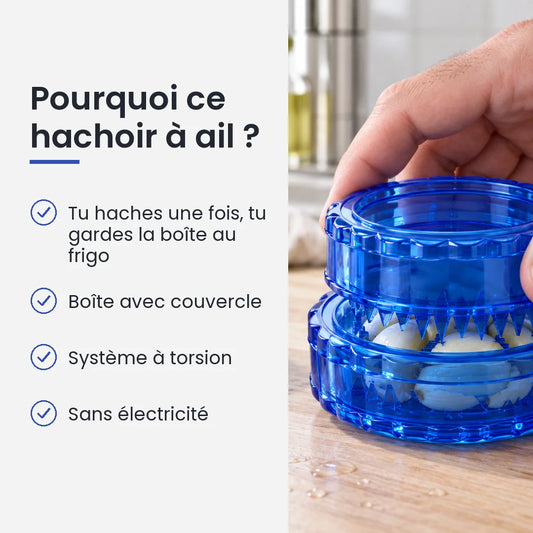
Transparent twist garlic chopper
Vendor:Hachoir CuisineRegular price $18.00 USDRegular priceUnit price per$22.00 USDSale price $18.00 USDSale -
White 3-in-1 rotary chopper
Vendor:Hachoir CuisineRegular price $66.00 USDRegular priceUnit price per$82.00 USDSale price $66.00 USDSale -
Red 3-in-1 rotary chopper
Vendor:Hachoir CuisineRegular price $66.00 USDRegular priceUnit price per$82.00 USDSale price $66.00 USDSale -
Blue 3-in-1 rotary chopper
Vendor:Hachoir CuisineRegular price $66.00 USDRegular priceUnit price per$82.00 USDSale price $66.00 USDSale -
Stainless steel herb chopper
Vendor:Hachoir CuisineRegular price $29.00 USDRegular priceUnit price per$36.00 USDSale price $29.00 USDSale -
14-in-1 Vegetable Chopper
Vendor:Hachoir CuisineRegular price $40.00 USDRegular priceUnit price per$51.00 USDSale price $40.00 USDSale -
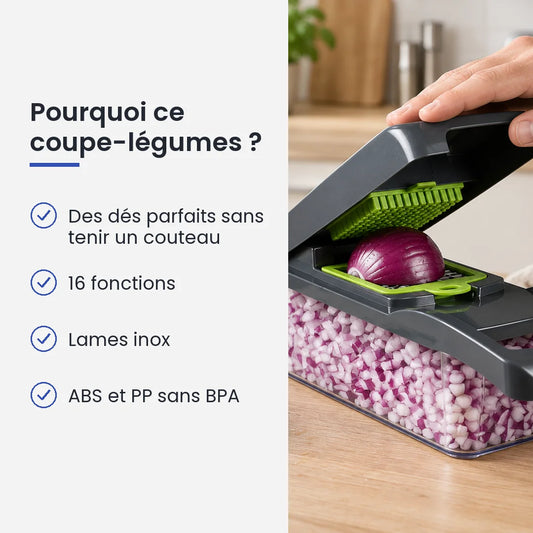
16-in-1 Vegetable Chopper
Vendor:Hachoir CuisineRegular price $42.00 USDRegular priceUnit price per$52.00 USDSale price $42.00 USDSale -
12-in-1 Vegetable Chopper
Vendor:Hachoir CuisineRegular price $40.00 USDRegular priceUnit price per$51.00 USDSale price $40.00 USDSale -
Garlic and ginger chopper
Vendor:Hachoir CuisineRegular price $15.00 USDRegular priceUnit price per$19.00 USDSale price $15.00 USDSale -
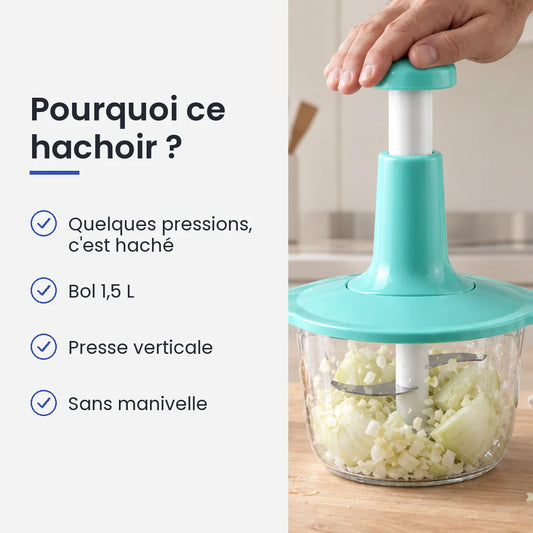
1.5 L Manual Pusher Chopper
Vendor:Hachoir CuisineRegular price $30.00 USDRegular priceUnit price per$37.00 USDSale price $30.00 USDSale -
Red manual vegetable chopper
Vendor:Hachoir CuisineRegular price $47.00 USDRegular priceUnit price per$59.00 USDSale price $47.00 USDSale -
5-in-1 Electric Chopper and Grater
Vendor:Hachoir CuisineRegular price $172.00 USDRegular priceUnit price per$215.00 USDSale price $172.00 USDSale -
Professional double chopper 2000 W
Vendor:Hachoir CuisineRegular price $167.00 USDRegular priceUnit price per$210.00 USDSale price $167.00 USDSale -

 Sold out
Compact green string cutter
Vendor:Hachoir CuisineRegular price $23.00 USDRegular priceUnit price per$29.00 USDSale price $23.00 USDSold out
















What to know about this collection
Why use a vegetable chopper instead of a knife?
For uniformity, above all. A brunoise cut with a knife requires technique and time, and even the slightest size discrepancy shows during cooking: small pieces burn while large ones remain raw. A vegetable chopper produces an even cut in a few seconds, which changes the result as much as the time spent.
The physical effort saved is also significant. Mincing 1 kg of onions for a soup or ratatouille wears out the hand and eyes. A closed bowl solves both problems at once.
Which vegetables can be processed in the chopper?
Most, provided you respect the starting texture.
- With no difficulty: onion, shallot, garlic, bell pepper, zucchini, mushroom, firm tomato
- With a little more effort: carrot, celeriac, raw beetroot, turnip
- To avoid: very fibrous vegetables such as whole leeks, or overly watery ones like peeled cucumber, which release their water and turn into purée
The simple rule: cut into 2 to 3 cm pieces before putting them in the bowl. A whole vegetable blocks the blades and produces an uneven result. Our guide explains how to chop vegetables quickly and effortlessly.
Which vegetable chopper for which vegetable?
An onion is not chopped like a raw carrot. Tender, watery vegetables are chopped quickly but turn into purée just as fast; hard vegetables require strength or a motor, and herbs are ruined in just a few seconds too long. The table pairs each vegetable family with the right appliance and the correct technique.
| Vegetable | Suitable appliance | The right technique |
|---|---|---|
| Onion, shallot | Rope chopper, vertical press, or rotary crank chopper | Cut the onion into quarters, 3 or 4 short pulses, no more |
| Garlic, ginger | Small rotary chopper, twist chopper, or garlic press | A small capacity, so the cloves stay under the blade |
| Carrot, potato, beetroot | Electric bowl chopper, preferably glass | 2 cm pieces, bowl filled halfway at most |
| Zucchini, bell pepper | Rope chopper or electric bowl chopper | Two pulses for the zucchini, bell pepper cut into strips beforehand |
| Parsley, coriander, basil | Rope chopper or mini chopper | Very dry herbs, short chopping so they do not turn black |
Two practical details: raw potato turns black quickly once chopped, prepare it at the last moment or cover it with cold water; beetroot stains, and a glass bowl is easier to clean than plastic. For large quantities of hard vegetables, see our electric glass bowl choppers.
Which type of vegetable chopper should you choose?
Most of the collection is manual, complemented by a few electric models. On the manual side, several mechanisms coexist, and they do not produce the same result.
| Type | Result obtained | Ideal for |
|---|---|---|
| Rope chopper, from 500 ml to 1 liter | Chopped more or less finely depending on the number of pulls | Garlic, onions, herbs, everyday vegetables |
| Rotary crank chopper | Free chopping, fineness adjustable by the number of turns | Onions, sauce bases, small vegetables |
| Vertical press 1.5 L | Chopped by successive presses | Onions, garlic, bell peppers in large quantities |
| Multifunction vegetable cutter 12 to 16 in 1 | Cuts, grates, slices, or juliennes depending on the blade chosen | Vegetables, fruits, onions, nuts |
| 3 in 1 drum rotary chopper | Grated or chopped, depending on the drum | Cheese, vegetables, nuts, garlic |
| Press, twist, or rotary for garlic | Pressed or finely chopped garlic | Garlic, ginger, seasonings |
The rope chopper is the simplest for everyday use. The multifunction vegetable cutters cover the most tasks with a single tool, thanks to their interchangeable stainless steel blades. To compare models according to your vegetables, see our guide to the best vegetable chopper.
How to get an even chop instead of purée?
This is the most frequent question, and the answer lies in three steps.
- Proceed in short bursts, never continuously. A few turns, check, and repeat.
- Only fill the bowl two-thirds full. If too packed, the vegetables spin on themselves without meeting the blades, then suddenly turn into purée.
- Cut into pieces of uniform size before starting. Uneven pieces at the start will result in an uneven cut.
For onions in particular, a closed bowl also prevents tears: the volatile compounds remain inside. Our article details how to chop an onion without crying.
How to maintain a vegetable chopper?
The bowls of the rope choppers and the drums of the 3 in 1 rotary choppers come apart for quick cleaning. The multifunction vegetable cutters are washed by hand, in water at 60 °C maximum, and the 520 and 900 ml crank choppers are also washed by hand. Rinse immediately after use, before the fibers dry on the blades.
For thin and even slices, a kitchen mandoline goes further than a chopper, and for fries or spiralized vegetables, see our fry cutters and spiralizers.
Onion chopper: which model for mincing without crying?
Mincing an onion with a knife requires technique and brings tears. An onion chopper solves both: it cuts evenly in a few strokes, and its closed bowl retains some of the vapors that sting the eyes. The right model depends above all on the quantity of onions you prepare at once.
- Rope: two to three pulls are enough for an onion. Compact and without electricity, it is suitable for one person or a couple who chops one or two onions per meal.
- Crank or pusher: each turn rotates the blades, allowing you to stop at the right time, from coarse chop to fine mince for a stuffing. With a large bowl, it is suitable for a family that cooks vegetables several times a week.
- Electric: the fastest for several onions in a row or batch cooking. Proceed in short pulses, as a few seconds too long turns the onion into purée.
In terms of capacity, a 400 to 600 ml bowl is enough for one person or a couple, and 1 to 1.5 liters for a family. Prefer stainless steel blades, which cut instead of crushing, and a fully detachable appliance: the smell of onion gets stuck in a bowl that is difficult to open.
To cry less, place the onion in the refrigerator for 15 minutes before chopping it. After use, disassemble and wash the bowl immediately; rinsing with a little lemon juice or baking soda neutralizes stubborn odors.
A chopper bought for onions also chops garlic, shallots, herbs, and firm vegetables like carrots. Just avoid very hard or frozen foods, which strain the blades.
Frequently asked questions about the vegetable chopper
Which vegetable chopper is the easiest to use?
The rope chopper: no assembly, no connection, you pull the cord a few times and you control the texture. For one or two cloves of garlic, the twist chopper is even simpler, since you just need to turn the lid of the box.
Which chopper should you choose for garlic?
For chopped garlic, a PP twist chopper, whose box is also used to store garlic in the refrigerator, or the rotary chopper for garlic and ginger. For pressed garlic, the zinc alloy and stainless steel garlic press. All dedicated models are in the garlic press and garlic chopper collection.
Manual or electric vegetable chopper: which one to choose?
As soon as carrots and celery come up often, or volumes regularly exceed 500 g, a motor avoids fatigue. The 250 W 5 in 1 electric chopper grates and slices carrots, cabbage, potatoes, and cheese, without blending. The rest of the range is found in the electric choppers. Below these volumes, the manual one does the same job, never breaks down, and fits in a drawer.
Can you chop meat and vegetables with the same chopper?
Yes for small portions: the red manual chopper with a transparent bowl chops vegetables, onions, garlic, and meat for a stuffing or meatballs. For raw meat in large quantities, a grid chopper remains more suitable: our meat choppers are made for that.